
From The Sourcing Paradox series · Week 2: The talent pipeline · First shared on LinkedIn, October 12, 2026
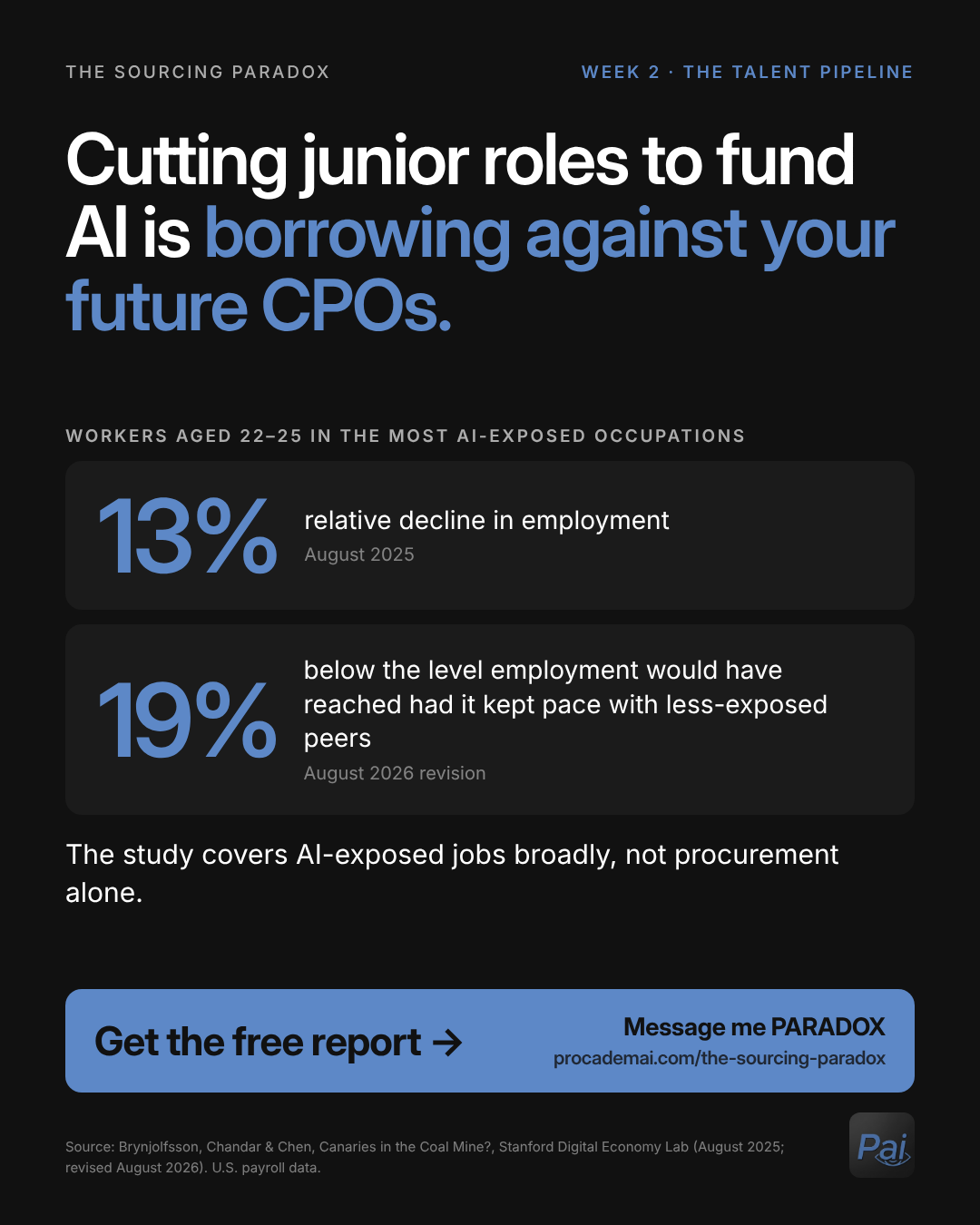
Stanford researchers found that workers aged 22 to 25 in the most AI-exposed occupations saw a 13% relative decline in employment. Their August 2026 revision puts that group's employment 19% below the level it would have reached had it grown in line with less-exposed peers.
That study covers AI-exposed jobs broadly, not procurement alone. In my view, procurement faces the same shift. The entry-level work AI absorbs first, like spend classification, contract review and RFP drafting, is the work that builds commercial judgment.
My bet: cut those roles and the savings show up this year. The cost shows up in five years, when you need a category director and no one is ready.
So which is your team doing with junior seats right now: cutting them, freezing them, or redesigning them?
Get the free report
This post draws on The Sourcing Paradox, a free Procademai™ report for procurement leaders and professionals (section 4, 4.1).
Get The Sourcing Paradox, free
Sources
- Brynjolfsson, Chandar & Chen, Canaries in the Coal Mine? Six Facts about the Recent Employment Effects of Artificial Intelligence, Stanford Digital Economy Lab (August 2025; revised August 2026). Source
Prepared with the assistance of AI; errors are possible. Views are Procademai™'s unless a source is cited. Organization names belong to their owners; mention does not imply endorsement.
© 2026 Procademai / Holman & Holman LLC. Procademai™ and Holman Group AZ are affiliated brands of Holman & Holman LLC. Other affiliated business interests exist and apply where used.